 how to not give a fuck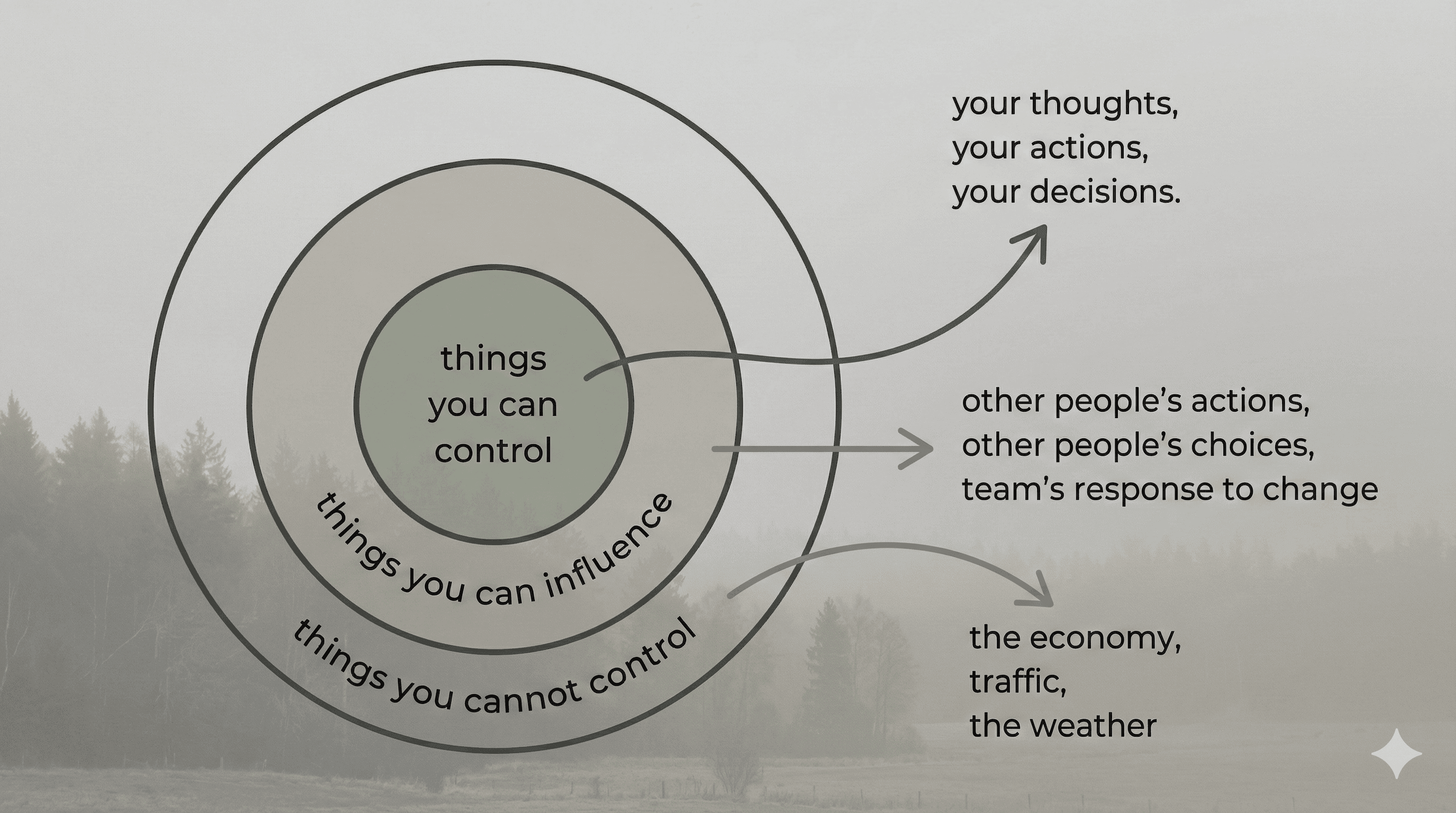
you don't control what happens to you
let's get this out of the way: you don't control other people. you don't control the economy. you don't control the weather, traffic, your boss's mood, or whether that person texts you back.
you already know this intellectually. but emotionally? you act like you can control all of it. you stew over a coworker's comment for three days. you refresh your email waiting for a response that isn't coming. you argue with strangers on the internet as if winning will change anything.
every minute spent trying to control the uncontrollable is a minute stolen from what you actually can change. epictetus, a former slave who became one of stoicism's greatest teachers, put it simply: "make the best use of what is in your power, and take the rest as it happens."
the circle of control
draw two circles, one inside the other.
the inner circle is yours. your thoughts. your reactions. your effort. your attitude. your choices. your words. your habits. this is the only territory you actually govern.
the outer circle is everything else. other people's behavior. outcomes. results. luck. what gets said about you when you leave the room. none of this is yours to manage.
most people spend 80% of their energy in the outer circle and wonder why they feel powerless. flip that ratio. pour 80% of your energy into the inner circle — what you think, how you respond, what you do next — and watch how different life feels.
this isn't about giving up on influencing the world. you can still work toward goals, advocate for change, build things. but you do it from a place of "i'll control my effort and let go of the result" rather than "i need this specific outcome or i'll spiral."
thought patterns that waste energy
there are a few mental habits that drain you faster than anything else. learn to spot them:
rumination — replaying past events on loop, editing the script of what you should have said. the past is a closed door. knocking on it doesn't make it open.
catastrophizing — assuming the worst possible outcome is the inevitable one. your brain is a worst-case-scenario generator. that's its job — keeping you safe from imaginary tigers. you don't have to believe every story it tells.
mind reading — assuming you know what others think of you. you don't. you're projecting your own insecurities outward and calling it insight.
should-ing — "they should have known better." "this shouldn't be happening." should is a word for people who want the world to match their fantasy. the world doesn't owe you that.
each of these patterns is an attempt to control the outer circle. notice them. name them. and then redirect your attention inward.
building the observer mind
the goal isn't to stop thinking. that's impossible and anyone who tells you otherwise is selling meditation cushions. the goal is to create a gap between a thought arriving and you acting on it.
think of it as building a watchtower in your own mind. thoughts come and go like weather — clouds, storms, blue sky. the watchtower doesn't stop the weather. it just gives you a vantage point.
start small. when you feel a strong reaction — anger, anxiety, the urge to fire off a text you'll regret — pause. take one breath. ask: "is this in my circle?" if it's not, let it pass. you don't have to engage every thought that shows up.
this isn't suppression. suppression is shoving thoughts down and pretending they don't exist. observation is seeing them clearly and choosing not to let them drive. there's a massive difference.
the buddhist concept of "vipassana" — insight meditation — is built on this exact principle. you sit, you observe your thoughts without judgment, and you train the muscle of non-reactivity. you don't need to be buddhist to use the tool.
when you slip
you will slip. you'll spend an entire afternoon angry about something in the outer circle. you'll lie in bed catastrophizing about a meeting that's three weeks away. you'll check someone's social media for the fifth time today and compare yourself until you feel like garbage.
that's fine. the practice isn't about never slipping. it's about how quickly you notice and return to the inner circle.
a beginner might ruminate for a week before catching it. with practice, you catch it in a day. then an hour. eventually, you feel the pull toward the outer circle in real time and choose not to follow it.
seneca wrote letters to his friend lucilius about this exact struggle — and seneca was one of the wealthiest, most powerful men in rome. controlling your thoughts isn't something you master and then move on from. it's a daily practice that gets easier but never becomes automatic.
be patient with yourself. the fact that you noticed you slipped means the watchtower is working.