 how to not give a fuck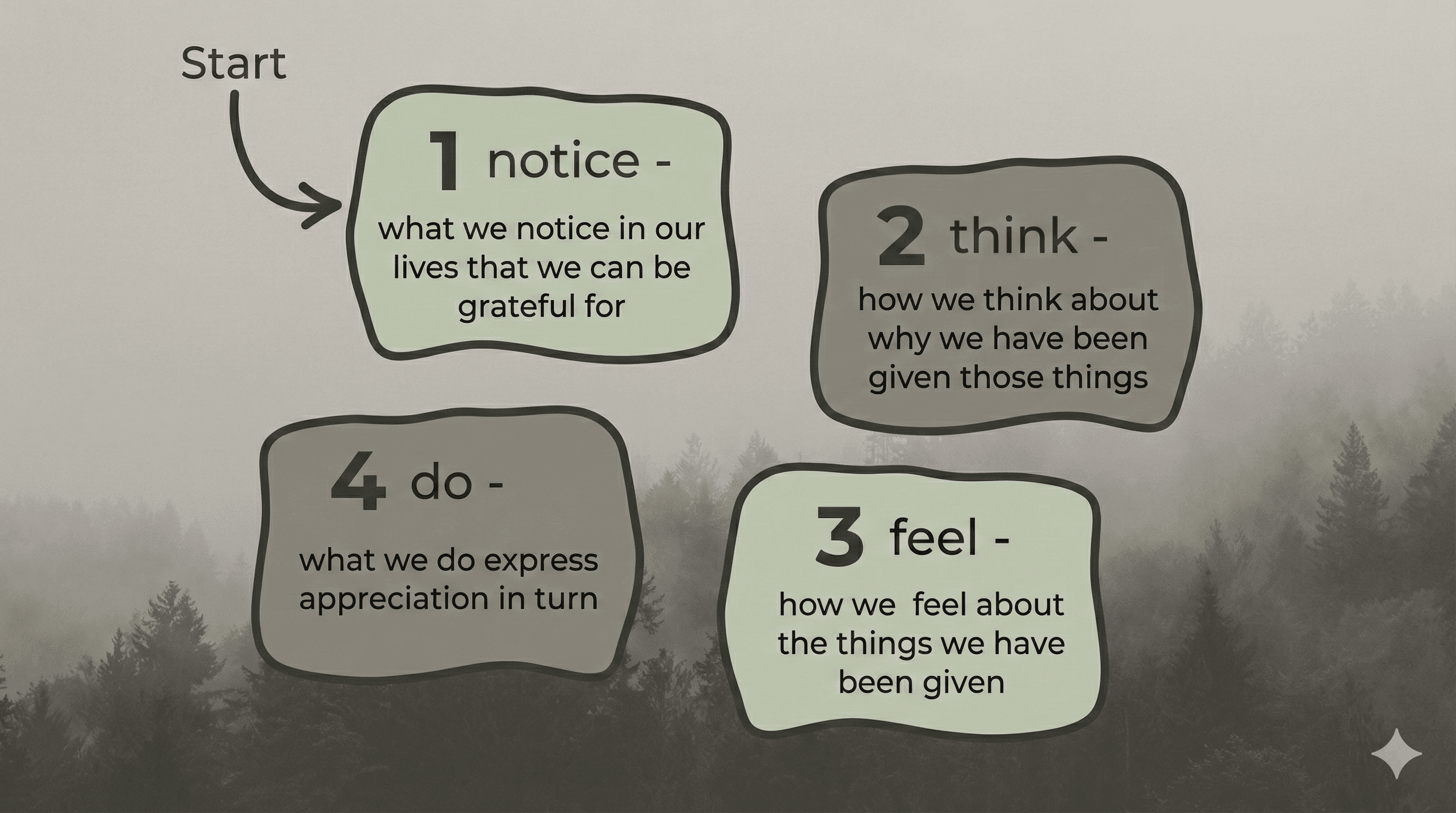
gratitude is not about being positive
let's clear up a misconception: gratitude isn't toxic positivity wearing a journal cover. it's not "look on the bright side" when your life is falling apart. it's not pretending everything is fine when it isn't.
real gratitude is attention. it's the discipline of noticing what's actually present instead of fixating on what's absent. and it's harder than it sounds, because your brain is wired for the negative.
evolutionary psychology calls it the negativity bias — your ancestors survived by noticing threats, not sunsets. that wiring kept them alive on the savanna. it keeps you miserable in a modern world where most of the "threats" are emails and social media comparisons.
gratitude is the counterweight. not a denial of problems, but a refusal to let problems be the only thing you see.
the four-step gratitude loop
this isn't complicated, but it is specific. vague gratitude — "i'm grateful for my life" — doesn't do much. specificity is what rewires the brain.
notice. pay attention to something concrete. not "my health" but "my legs carried me on a walk this morning." not "my friends" but "sarah called to check on me when she didn't have to."
think about why. why do you have this thing? maybe it's effort you put in. maybe it's luck. maybe someone chose to show up for you. acknowledging the source deepens the feeling.
feel it. don't rush past this step. most people intellectualize gratitude without letting it land in their body. sit with it for ten seconds. let it register somewhere other than your prefrontal cortex.
act. do something with it. tell sarah her call meant something. take care of the body that carried you on that walk. write it down so future-you can read it on a bad day.
notice, think, feel, act. that's the loop. run it once a day and your baseline shifts within weeks. neuroscience backs this up — gratitude practices physically alter neural pathways associated with well-being.
gratitude when life is hard
here's where most gratitude advice falls apart. it's easy to be grateful when things are going well. the real test is whether you can find something — anything — when life has knocked you down.
you don't have to be grateful for the suffering. nobody's asking you to thank the universe for your pain. but can you find one thing in the wreckage that's still intact? one relationship that held? one small comfort that's still available?
the stoics had a practice called "premeditatio malorum" — the premeditation of evils. they'd deliberately imagine losing everything so they could appreciate what they had right now. not as pessimism, but as a tool for presence.
you don't need to imagine it if you're living it. but even in the worst seasons, there is usually one thread you can grab. finding it isn't naive. it's survival. it's the thing that keeps you moving when everything in you wants to stop.
viktor frankl, a psychiatrist who survived the concentration camps, wrote that even in the most dehumanizing conditions, people could choose their attitude. he didn't say it was easy. he said it was possible. and that possibility is where gratitude lives — not in the easy moments, but in the ones where it costs you something to find it.
daily practice methods
you don't need a fancy system. pick one:
the evening three. before bed, write down three specific things from the day. not "good weather" — specific. "the barista remembered my order and it made me feel seen." the specificity is what makes it work.
the gratitude pause. once a day, stop what you're doing and spend 60 seconds running the four-step loop on whatever is directly in front of you. your coffee. the quiet room. the fact that you're breathing without thinking about it.
the gratitude text. once a week, send one message to someone telling them specifically what they mean to you or what they did that mattered. this one transforms relationships.
the contrast method. when something good happens, briefly imagine your life without it. not to scare yourself, but to feel the weight of having it. you appreciate the roof when you imagine the rain.
consistency matters more than intensity. five minutes daily beats an hour-long journaling session once a month. you're building a habit, not performing a ritual.
gratitude and letting go
gratitude and non-attachment aren't opposites. they're partners.
you can deeply appreciate something while accepting that it might not last. in fact, knowing it won't last is what makes gratitude sharp. the japanese concept of "mono no aware" — the bittersweet awareness of impermanence — captures this perfectly.
the cherry blossoms are beautiful because they fall. the meal is savored because it ends. the person across from you is precious because neither of you will be here forever.
this isn't morbid. it's awake. gratitude without impermanence becomes entitlement — "i have this and i deserve to keep it forever." gratitude with impermanence becomes presence — "i have this right now and i'm not going to waste it."
that intersection — fully appreciating what you have while holding it loosely — is where not giving a fuck meets giving all the fucks that matter.